Wisen IT Solutions

Master High-Performance Data Analysis With Polars

Process DataFaster with Polars

Learn Polars for fast DataFrame processing, data cleaning, transformation, analytics, and high-performance Python data workflows.

Start Your AI-Paired JourneyStart Your AI Journey
Polars training in lazy evaluation, expressions and high-performance data processing at Wisen IT Solutions, Chennai, India
The Wisen Difference

Polars Training for AI-Ready Data Engineer Careers

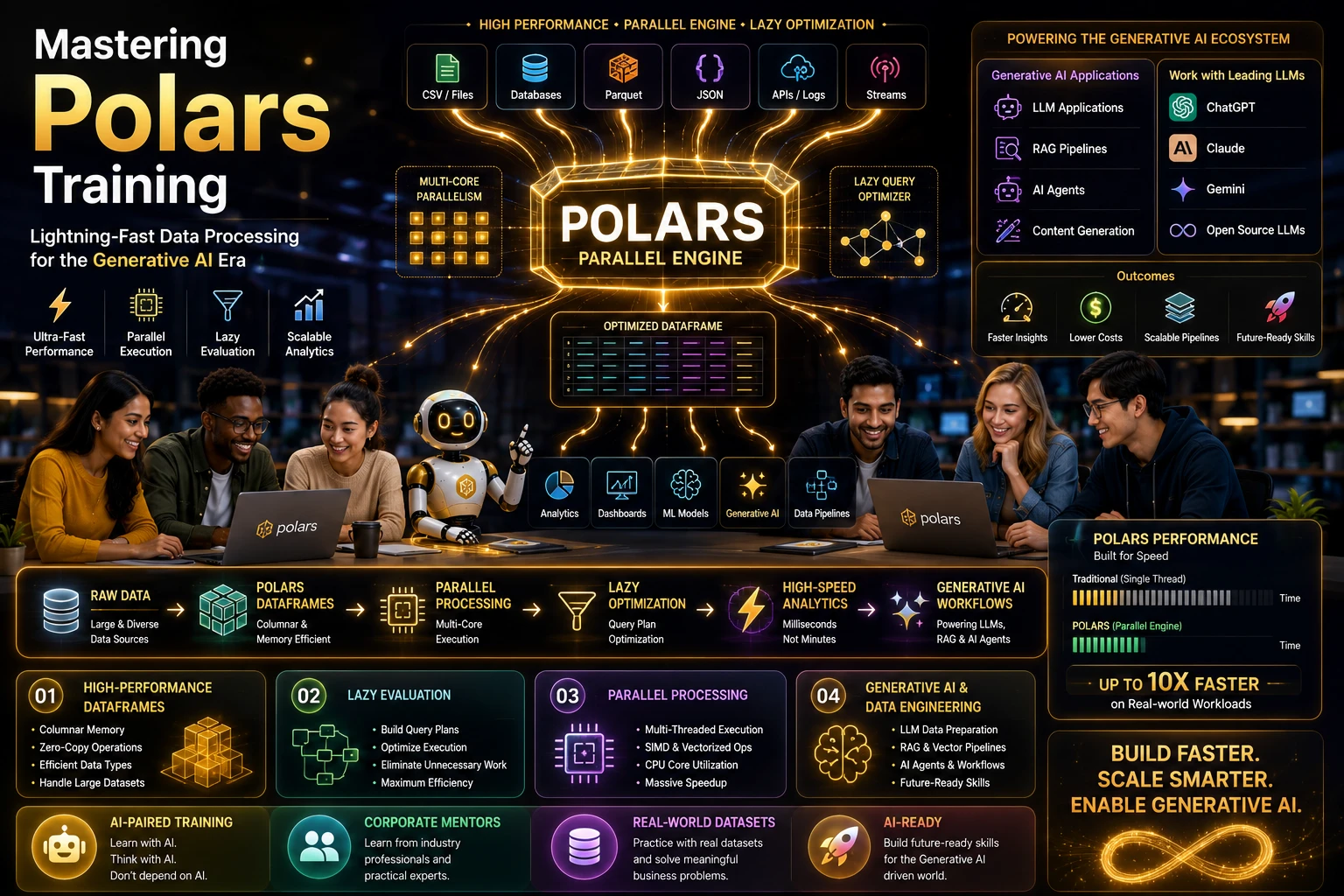
Polars Training at Wisen, Chennai, India, develops practical skills for high-performance data processing with the modern Python DataFrame library. Learn DataFrames, expressions, lazy evaluation, data transformation, joins, aggregations, filtering, grouping, data types, CSV and Parquet processing, and performance optimization through project-focused, AI-Assisted Learning.

  • Project-Ready Technical Skills
  • AI-Ready Polars Technical Skills
  • Corporate-Validated Polars Curriculum
  • AI-Resilient Data Engineering Skills
  • 17,700+ Learners Trained to Date
  • Trusted by Corporates and Academia

Modern Polars Development for AI-Driven Industries.Build with AI. Think Like an Engineer.

Wisen IT Solutions, Chennai, India

Load. Transform. Accelerate.

Polars Training for the AI-Era

Build practical Polars skills for the AI-Era through hands-on training in DataFrames, data loading, filtering, expressions, transformations, aggregations, joins, lazy evaluation, and high-performance data processing. Learn to work efficiently with large datasets, develop project-ready, AI-ready data processing skills, and open new AI-driven career opportunities in data analysis, data engineering, and Python development.

Chapter 01

Introduction to Polars Topics

  • What is Polars?
  • Why a New DataFrame Library?
  • Polars vs Pandas
  • Rust & Arrow Foundation
  • Columnar Memory Model
  • Multi-threaded Execution
  • Installing Polars
  • Import Conventions
  • Series and DataFrame
  • Creating a DataFrame
  • Inspecting with head & tail
  • schema and dtypes
  • describe()
  • Your First Polars Script

Chapter 01

Introduction to Polars Topics

  • What is Polars?
  • Why a New DataFrame Library?
  • Polars vs Pandas
  • Rust & Arrow Foundation
  • Columnar Memory Model
  • Multi-threaded Execution
  • Installing Polars
  • Import Conventions
  • Series and DataFrame
  • Creating a DataFrame
  • Inspecting with head & tail
  • schema and dtypes
  • describe()
  • Your First Polars Script

Corporate Polars training for data teams at Wisen IT Solutions, Chennai, India

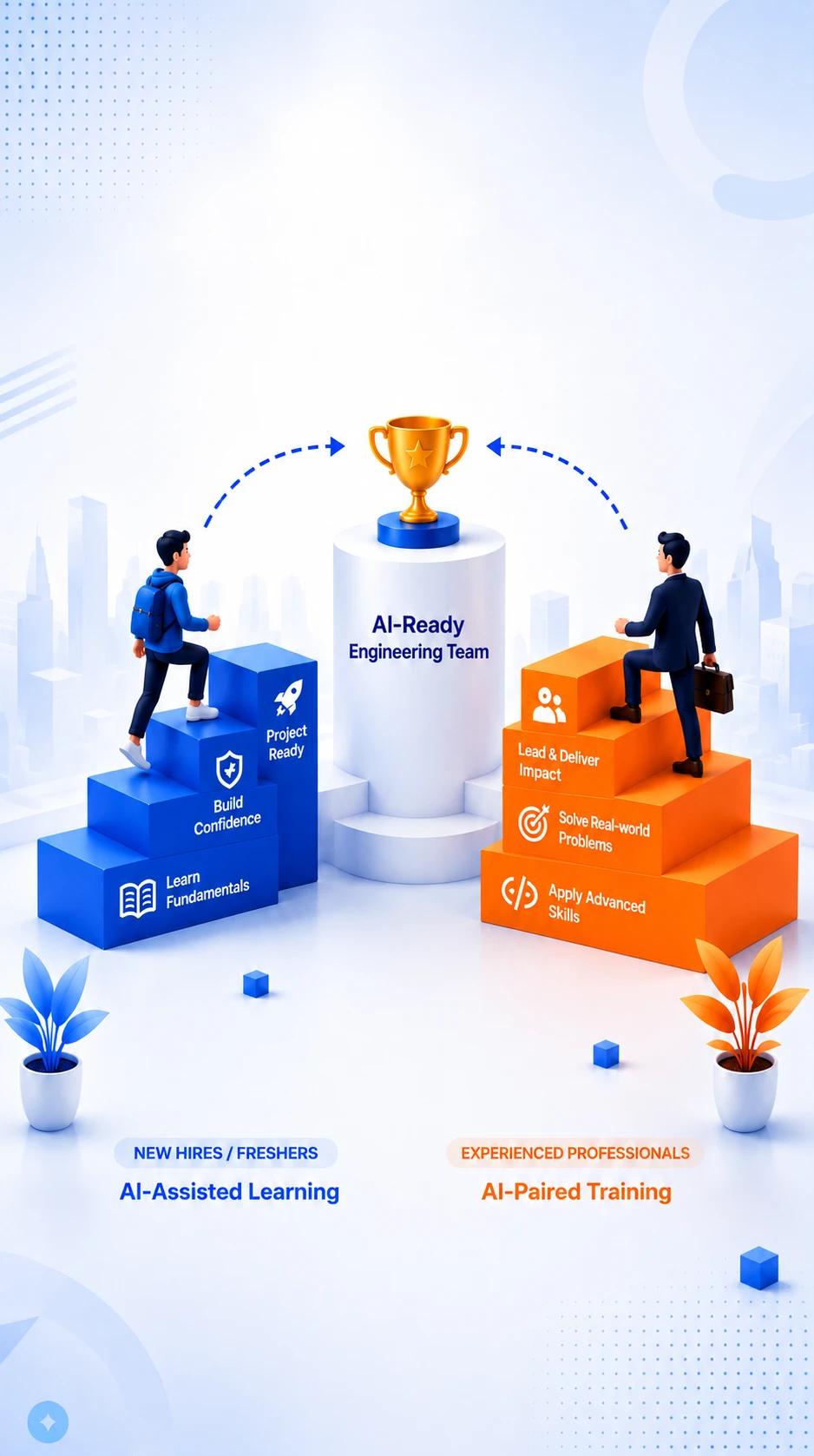
Moving Beyond
Traditional Training
with
AI-Enabled Learning.

AI-Ready Technology
Learning Lab

Moving Beyond
Traditional Training
with AI-Enabled Learning

For Organizations

Corporate Polars Training

Build modern data processing capabilities through AI-Enabled Learning across Polars DataFrames, Lazy Evaluation, Data Transformation, Query Optimization, Data Pipelines, and AI-Assisted Data Workflows. Wisen’s Polars Training combines AI-Assisted Learning for understanding modern data processing concepts with AI-Paired Training for practical application, enabling professionals to build efficient data workflows while retaining analytical thinking, technical judgment, and ownership.

Industry-Relevant Polars Skills

Develop practical Polars skills aligned with modern high-performance Python data processing and analytics workflows.

AI-Enabled Learning

Use AI to accelerate data exploration, coding, optimization, debugging, and problem-solving without replacing analytical thinking.

Induction & Upskilling Programs

Build structured learning paths for new hires, freshers, and existing professionals developing or strengthening their Polars skills.

Hands-On Data Workflows

Practice DataFrame operations, lazy evaluation, data transformation, query optimization, and AI-assisted data pipeline workflows.

Customized Corporate Programs

Align training with your team’s roles, datasets, technology stack, data workloads, projects, and organizational objectives.

AI-Evaluated Skill Development

Evaluate practical progress through AI-assisted assessments that identify strengths, skill gaps, and areas for improvement.

Looking for a tailored Polars training program for your organization? Let’s build the right learning journey for your team.

Explore Corporate Training Page
Process. Scale. Perform.

Skills You Gain from Polars Training

Develop practical skills for modern dataframe-based data processing with Polars Course concepts covering efficient data loading, transformation, expressions, lazy execution, and scalable analytical workflows. Build the ability to work with larger datasets while developing performance-aware thinking for Python data engineering, analytics, and AI- enabled workflows.

  • Modern DataFrame Skills

    Understand the Polars DataFrame model and develop a strong foundation for structured data processing.

  • Efficient Data Loading

    Load structured datasets efficiently and select appropriate approaches for different data-processing requirements.

  • Dataset Exploration

    Inspect schemas, understand data structures, and identify useful patterns before beginning transformation.

  • Data Selection

    Select relevant columns and records precisely to keep analytical workflows focused and efficient.

  • Data Filtering

    Apply conditions and expressions to isolate the data required for analysis or downstream processing.

  • Data Transformation

    Clean, convert, derive, and reorganize datasets using practical dataframe operations.

  • Expression-Based Processing

    Develop reusable expressions that make complex transformations clearer and more maintainable through Python Polars Course techniques.

  • Grouping and Aggregation

    Summarize large datasets using grouping, aggregation, and analytical operations.

  • Data Joining

    Combine related datasets using appropriate joining strategies while maintaining data integrity.

  • Data Reshaping

    Restructure datasets to support different analytical, reporting, and processing requirements.

  • Lazy Data Processing

    Understand lazy execution and how deferred computation can improve the efficiency of data workflows.

  • Query Optimization

    Develop performance-aware habits by understanding how processing plans can be optimized for efficient execution.

  • Large Dataset Processing

    Build confidence in working with larger datasets and selecting scalable approaches through Advanced Polars Course practices.

  • AI-Assisted Data Processing

    Use AI as a development partner to explore transformations, troubleshoot workflows, and improve solutions while retaining ownership of technical decisions through Python Polars Training.

  • Scalable Data Workflow Design

    Apply Polars Online Course concepts to design efficient workflows that can support modern analytics, engineering, and AI applications.

Career Transformation Starts Here!

These skills help you move beyond basic dataframe manipulation toward efficient, scalable data processing. Strengthen your practical knowledge through Polars Python Course concepts and continue building expertise with Polars Course Online learning practices for modern Python data workflows.

91-900 31 31 555
Learn. Practice. Master Polars

Polars Training Course Materials

Polars Course learning materials with expression notes, lab activities and exercises

This Polars Course is taught from material developed over 27+ years of Python training and data engineering experience, then rebuilt around Polars itself — its expression API, its lazy evaluation, and the habits that carry over badly from other DataFrame libraries.

Every chapter, expression example, lab activity, and exercise in the Polars Online Course works on datasets large enough for query planning and column selection to show their effect, so you learn the Polars way of thinking rather than translating older code line by line.

What You'll Receive

Polars Concept Notes

Explanations of DataFrames, expressions, contexts, and lazy frames written for study between sessions.

Guided Lab Activities

Labs that take a dataset from scan to filtered, grouped, and aggregated output using expression chains.

Hands-on Exercises

Independent Python Polars Course tasks on joins, window functions, and lazy query construction.

Performance Comparisons

Side-by-side examples showing how eager and lazy execution differ on the same workload.

Progressive Learning Path

Topics arranged from first expressions to streaming, query optimisation, and advanced Polars Course material, without skipped steps.

Revision and Reference Sheets

Handy references for expression syntax and the API differences that most often trip up newcomers.

What Makes Our Polars Learning Materials Different?

27+ Years of Experience

Authored by trainers whose Python data teaching predates Polars by decades and keeps pace with it.

Human-Authored Content

Every page is written and maintained by the trainers delivering the Polars Training.

Original Learning Materials

Developed in-house rather than reassembled from documentation or blog posts.

Practice First

Each idea is paired with an expression you write and a result you verify.

Tracks a Fast-Moving Library

Revised as Polars releases land, so examples match the version you install today.

AI-Assisted Quality Review

AI is limited to grammar, readability, and presentation improvements.

Our Commitment

What we publish is what we teach, session by session.

The Polars topics on this website describe the actual learning journey of our live instructor-led online training. We follow the published order and add further query walkthroughs, optimisation insights, and real-world data engineering scenarios whenever they strengthen the learning. Python Polars Training runs live online, so learners in Chennai and elsewhere receive identical material.

Experience DrivenPractice FocusedResults Oriented
Query. Review. Become Pipeline-Ready.

Polars Course Evaluation

Polars Training is evaluated independently by an experienced trainer and by an AI review of your code. The trainer looks at how you express a query; the AI evaluation looks at what that expression actually costs and returns.

Most learners arrive carrying habits from other DataFrame libraries. This Polars Course evaluates whether you have moved to expressions and lazy execution, or are still writing older code in new syntax.

Human Evaluation

Our experienced trainers evaluate your ability to:

Expression Thinking

Build work from Polars expressions and contexts rather than row-by-row edits.

Eager and Lazy Choice

Decide when a LazyFrame earns its keep and when eager execution is simpler.

Schema Discipline

Track dtypes and schema through a pipeline and correct them deliberately.

Transformation Skills

Filter, select, aggregate and window over data with chained expressions.

Join Correctness

Join large frames with the right strategy and verified row counts.

Reading Query Plans

Explain what the optimiser did and why the plan looks as it does.

Debugging Pipelines

Isolate failures in a long chain instead of rewriting it wholesale.

Performance Judgement

Say why one formulation is faster, with evidence rather than folklore.

Pipeline Readiness

Deliver a data pipeline that holds up on datasets larger than memory comfort.

Independent AI Evaluation

Our independent AI evaluation reviews your Polars programs to assess:

Concept Application

Verify correct use of expressions, contexts and lazy evaluation.

Query Logic

Analyse whether the chain computes what the requirement described.

Polars Practices

Evaluate adherence to idioms taught in the Python Polars Course.

Code Quality

Review chain readability, naming and the reuse of expressions.

Correctness Risks

Identify schema drift, null handling gaps and unintended row growth.

Performance Analysis

Suggest projection pushdown, streaming and cheaper joins.

Best Practices

Recommend improvements based on Advanced Polars Course standards.

Engineering Readiness

Evaluate whether the pipeline is fit to run on a schedule.

Why Dual Evaluation?

Human trainers evaluate whether you are genuinely thinking in expressions.

AI independently reviews the query, its schema safety and its execution cost.

Together they turn code that works on a sample into code that works in production.

Learning Outcome

By combining Human Evaluation with Independent AI Evaluation across the Polars Online Course, you will:

  • Write expression-first Polars rather than translated Pandas
  • Use lazy execution and query plans deliberately
  • Keep schemas and null handling under control end to end
  • Justify performance decisions with the plan, not guesswork
  • Become project-ready for data engineering and high-volume analytics work
AI-Assisted Polars Learning

Polars Course Duration & Batch Timings

The Python Polars Course runs live from Wisen IT Solutions, Chennai in two paces, so a fast DataFrame library is never taught at a speed that outruns the learner.

Total Learning Hours

40 - 45 Hours

Instructor-led expression sessionsLazy query practicePerformance labsPipeline project work

Normal Track

2.5 Hours / Session

A measured pace for learners taking the Polars Course alongside a job or a degree.

  • Working Professionals
  • College Students
  • Data Engineers
  • Weekend Batches

Fast Track

5 Hours / Session

A compressed schedule for those who want the Polars Online Course completed quickly.

  • Full-time Learners
  • Job Seekers
  • Fresh Graduates
  • Analytics Aspirants

What's Included?

Live Instructor-Led Training

Expression API Learning

Hands-on Polars Coding

Lazy Frame Lab Activities

Join & Aggregation Exercises

AI-Assisted Learning

Independent Code Evaluation

Doubt Clarification

Performance Project Guidance

Same Curriculum |
Same Labs |
Same Evaluation |
Same Learning Outcome

Both tracks of the Advanced Polars Course cover the same Polars Python Course syllabus. Only the delivery pace of Python Polars Training changes; nothing is trimmed to save time.

Balanced Learning. Expression Fluency. Faster Pipelines.

Lecture-Practical Ratio

The expression API is the whole of Polars, and fluency in it comes from writing it. This Polars Course follows a 50:50 Lecture-Practical Ratio, so every expression, context and lazy-frame idea is composed by you on a live frame within the same session.

The Polars Training has you build query plans, inspect them, and watch lazy evaluation reorder your work — the reasoning the Advanced Polars Course depends on throughout.

50%Theory

Understand the expression engine behind the speed.

  • Eager versus lazy execution
  • Expressions and contexts
  • Arrow-backed columnar storage
  • Query plan optimisation
  • Strict typing and null handling
  • Streaming for larger-than-memory data
50:50Balanced Learning

50%Practical

Compose and profile real query pipelines in class.

  • Live expression-building demos
  • select, filter and with_columns labs
  • group_by and window function exercises
  • Join and concat practice
  • Lazy pipeline and plan inspection sessions
  • Pandas-to-Polars migration tasks
  • AI-assisted query refactoring exercises

Why a 50:50 Split Works for Polars

Think in Expressions

Stop writing row loops and start describing columns.

Chain It Yourself

Long pipelines only feel natural once you have written them.

Read the Query Plan

Explain what the optimiser did before it ran your code.

Measure the Gains

Benchmark a lazy pipeline against the eager version.

Handle Bigger Data

Finish the Polars Online Course ready for data that no longer fits in memory.

Our Learning Philosophy

Every Polars concept is followed by a pipeline you compose and profile yourself.Wisen IT Solutions, Chennai runs this Python Polars Training on the principle that a fast DataFrame library is learned by building queries, not by comparing benchmarks on slides.

Fresh Start. Expression-First. Pandas Experience Optional.

Polars Course Prerequisites

You can join this Polars Course with basic Python and nothing else. Prior Pandas experience is welcome but never assumed — expressions, contexts and lazy frames are taught as a first language, not as a translation.

The Polars Training is live online, so the Python Polars Training batch and the Polars Course Online batch write their first expression in the same session, against the same dataset.

Working Python Basics

  • Variables, lists and dictionaries
  • Chaining method calls on an object
  • Reading a function signature
  • Running code in a notebook or a script

Interest In Performance

  • Curiosity about why a query is slow
  • Patience to read a query plan
  • Willingness to unlearn row-by-row habits
  • Commitment to the timed lab exercises

Setup For Polars

  • Windows OS with a stable internet connection
  • Python 3.x with venv — guided installation
  • Polars installed via pip, walked through in class
  • Parquet and CSV practice files supplied by us

Who Can Join?

Students & Graduates

Data & Analytics Engineers

Pandas Users Hitting Limits

Backend developers processing large data files

No Big-Data Stack Required

You do not need Spark, a cluster or a warehouse account to follow this Python Polars Course. Everything in the Advanced Polars Course runs on your own laptop, from your first select and filter to lazy pipelines over files larger than memory.

All you need is basic Python, a laptop and an appetite for faster data work.

We’ll take care of the rest!
Expressions. Lazy Plans. Arrow Memory.

Polars Course Tools & Technologies

This Polars Course teaches the expression API and the lazy engine first, because Polars rewards describing what you want and letting the query optimiser decide how to get it.

The Polars Training also covers the Arrow memory model and streaming over larger-than-memory files — the material that makes it an Advanced Polars Course rather than a Pandas translation guide. Python Polars Training runs live online.

Core Engine

DataFrame & Series

Expression API

LazyFrame

Query Optimiser

Multi-Threaded Execution

Transformations

select & filter

with_columns

group_by & agg

join & concat

Window Expressions

Nested & List Types

Arrow & I/O

Apache Arrow

scan_csv & scan_parquet

Streaming Engine

SQL Interface

Pandas Conversion

Performance & Migration

explain & Query Plans

Memory Profiling

Polars vs Pandas Benchmarks

Migrating Pandas Code

Strictness & Null Semantics

Learning Outcome

By the end of this Python Polars Course you can rewrite a slow Pandas pipeline as a lazy Polars plan, read the optimiser output, and process a file bigger than your RAM — what the Polars Online Course is built to deliver.

Think in Expressions

Build Lazy Pipelines

Stream Big Files

Migrate From Pandas

Got Questions - Quick Answers

Polars Training Frequently Asked Questions

27+
Years of Experience
17,700+
Professionals Empowered
2,700+
Happy Learners Every Year
30+
Corporate Clients

Corporate Training Clients

A Trusted Training Institute Upskilling Teams at Leading Companies Worldwide

A Wisen IT Solutions Python training advisor pointing towards the enquiry number

Build Future-Ready Skills. Gain Project-Ready Experience.
Succeed in AI-Transformed Careers.

The software industry is evolving with AI—not disappearing. Wisen's AI-Enabled Learning helps you master modern technologies, build strong engineering fundamentals, and collaborate effectively with AI tools like ChatGPT and Claude. Develop the practical skills, critical thinking, and real-world experience needed to build software with confidence and remain valuable throughout your career.

Talk to our AI Learning Advisor

+91 900 31 31 555